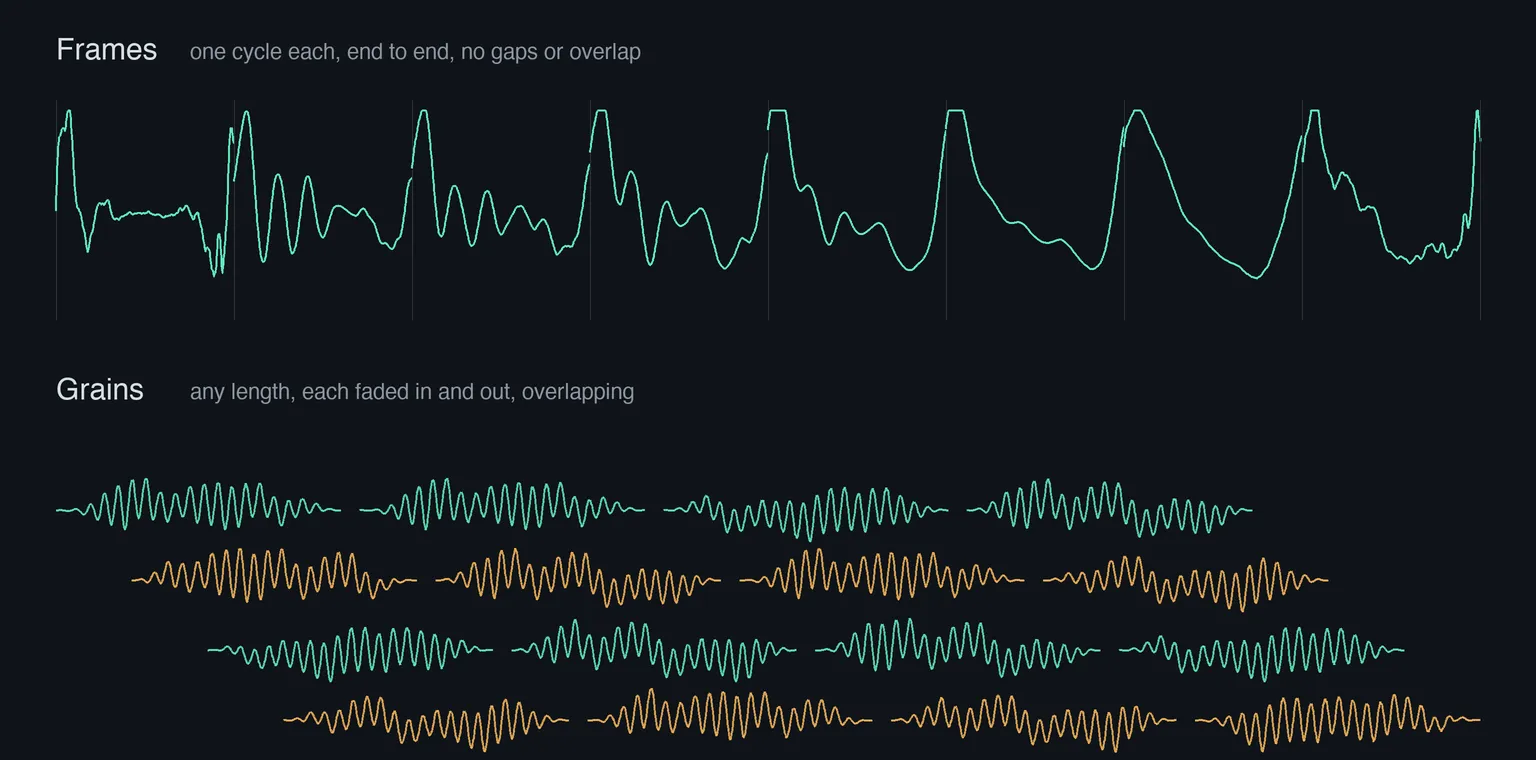
Granular synthesis and wavetable synthesis both play short pieces of audio from a position you can move. They sound different because of how those pieces are cut and how they’re played: a frame is one cycle repeated at the note you play, and a grain is a short sound that overlaps with others.
This guide assumes you know one or the other. For the basics, see the granular chapter and the wavetables chapter of Signal Function Set’s synthesis guide, or How wavetables work here. For the history, see the Granular Synthesis Workshop.
The examples use one recording, Emily Singing Alto in a Tunnel by emilyzitek (CC0), and a table from the recording guide.
Grains and frames
| Wavetable frame | Grain | |
|---|---|---|
| Length | Exactly one cycle of the note | Typically 10 to 200 ms, whatever the note |
| Envelope | None; the frame’s end meets its start | Each grain fades in and out |
| Overlap | None: one frame at a time, with neighbors blended | Usually many at once |
| Repeats | Continuously, at the note’s frequency | At the density you set, which can be random |
| Where it comes from | A stored table | A recording, a live input, or an oscillator |
Both have a position. A wavetable’s position picks a frame, and a granular instrument’s position picks the point in the recording that grains are taken from. Sweeping either one moves through the source, and holding either one still freezes it, at any speed you like and independent of pitch.
Here’s the voice with its position moving at a third of real time, then held at one point. Both use 80 ms grains, about 40 a second.
Pitch is the main difference
A wavetable oscillator plays a higher note by reading the frame faster, so the frame’s contents all move up together. Grains don’t have to work that way. Start the same grain more often and the pitch goes up with the rate, while each grain still plays at its original speed.
These two clips use the same 20 ms of the voice, at A1, A2 and A3. In the first, it’s a frame. In the second, it’s a faded grain repeated at the note’s frequency.
The frame gets brighter by an octave with each note, because its resonances move with the pitch. The grain’s resonances stay near where they were in the voice, so it keeps more of the sound of the voice as the note changes. Measured on these clips, the frame’s spectral centroid goes from about 270 to 550 to 1090 Hz, and the grain’s stays between about 210 and 250 Hz.
Most granular instruments also have a pitch control that resamples each grain, which does move the contents. It’s a choice there. On a wavetable, it’s how the oscillator works.
Overlap and randomness
A wavetable plays one moment of its source at a time. A grain cloud plays many: with 80 ms grains at 40 a second, about three are sounding at once, and scattering them (spray, or jitter on some instruments) mixes in sound from either side of the position. That’s why a frozen cloud sounds wide and moving, and a frozen wavetable sounds like one steady tone. A wavetable synth gets some of that thickness back from unison, with detuned copies of the same frame, and from modulating the position.
When to use each
Use a wavetable when:
- You want a note you can play across the keyboard, with a clear pitch and a steady level.
- You want the same sound every time, for a bass or a lead that has to sit in a mix.
- You’re playing it on hardware that loads tables, such as a Eurorack module. See frame sizes by synth.
- You want to design the timbre frame by frame.
Use granular when:
- You want to stretch or freeze a recording without changing its pitch.
- You want a texture rather than a note: pads, drones, clouds.
- You want a sound that doesn’t repeat exactly.
- You’re processing live input.
Synths that do both
- Serum 2: each main oscillator can switch between wavetable, sample, multisample, granular and spectral modes.
- Phase Plant: granular and wavetable are separate generators, so you can stack them in one patch.
- Pigments: two engines, each of which can be Wavetable, or Sample with a granular mode.
- Waldorf Quantum and Iridium: Wavetable and Particle oscillators. Particle covers sampling and granular synthesis, and includes a live granular mode.
In VCV Rack, Signal Function Set’s GSX and Flock are granular voices that generate their own grains, and the Flock In expander feeds Flock live audio.
One way to use both is to play a wavetable for the pitch and attack, with a quiet granular layer of the same source underneath for width.
Turn a granular texture into a wavetable
A table can capture the tone color of a texture, so you can play it as a note on an instrument with no granular engine.
- Bounce a few seconds of the texture to a file.
- In WaveStack, choose New › Sample and pick the file.
- Choose Raw slices or Spectral. Raw slices copies a short piece from each point in the file and squeezes it into a frame, so it’s a grain with no fade, apart from a short one at its ends so it loops. Spectral is smoother, and builds each frame from the harmonics at that point.
- Set the number of frames, then export it for your synth.
Here’s a 12-second cloud of the voice, and a table of 64 Raw slices at 20 ms each, scanned from the first frame to the last. It plays at 50 Hz because that’s the note where a 20 ms slice keeps its own speed; the recording guide explains why.
The table keeps the voice’s tone color as it scans, and the result is a pitched buzz. The cloud’s overlap and randomness are gone, because each frame is one fixed shape.
Use a wavetable as a granular source
This works the other way too. A wavetable WAV is ordinary audio with the frames stored end to end, so most granular instruments that load a WAV can read one, even without knowing it’s a table.
Played at its original speed, a 2048-sample frame at 44.1 kHz repeats at about 21.5 Hz, so raise the grain pitch. These clips use the guitar table from the recording guide with its 64 frames at eight times the speed, about 172 Hz. The first is the table scanned as a wavetable. The second is 60 ms grains from the same file, about 50 a second, moving through it over the same time.
Frequently asked questions
Is wavetable synthesis a kind of granular synthesis?
No, though they're related. Both play short pieces of audio from a position you can move. A wavetable frame is exactly one cycle, repeats with no gaps at the note you play, and is the only thing sounding at that moment. Grains can be any length, are usually faded in and out, and overlap, often taken from several points at once.
Why does a wavetable change character at high notes when a granular patch doesn't?
A wavetable frame is squeezed to play higher, so everything in it moves up with the note, including its resonances. A stream of grains can get higher by starting more often, while each grain keeps its own contents and speed, so its resonances stay where they are.
Can I make a wavetable from a granular texture?
Yes. Record or bounce the texture to a file, open it with New › Sample in WaveStack, and use Raw slices or Spectral. The table keeps the texture's tone color from moment to moment, but not its overlap or randomness, because a table plays one frame at a time.
Can a granular synth play a wavetable?
Usually, if it can load a WAV. A wavetable file is ordinary audio with the frames stored end to end. A 2048-sample frame at 44.1 kHz plays at about 21.5 Hz, so raise the grain pitch to bring it into a normal range.
Which synths have both granular and wavetable oscillators?
Serum 2, Phase Plant, Pigments, and the Waldorf Quantum and Iridium all have both.